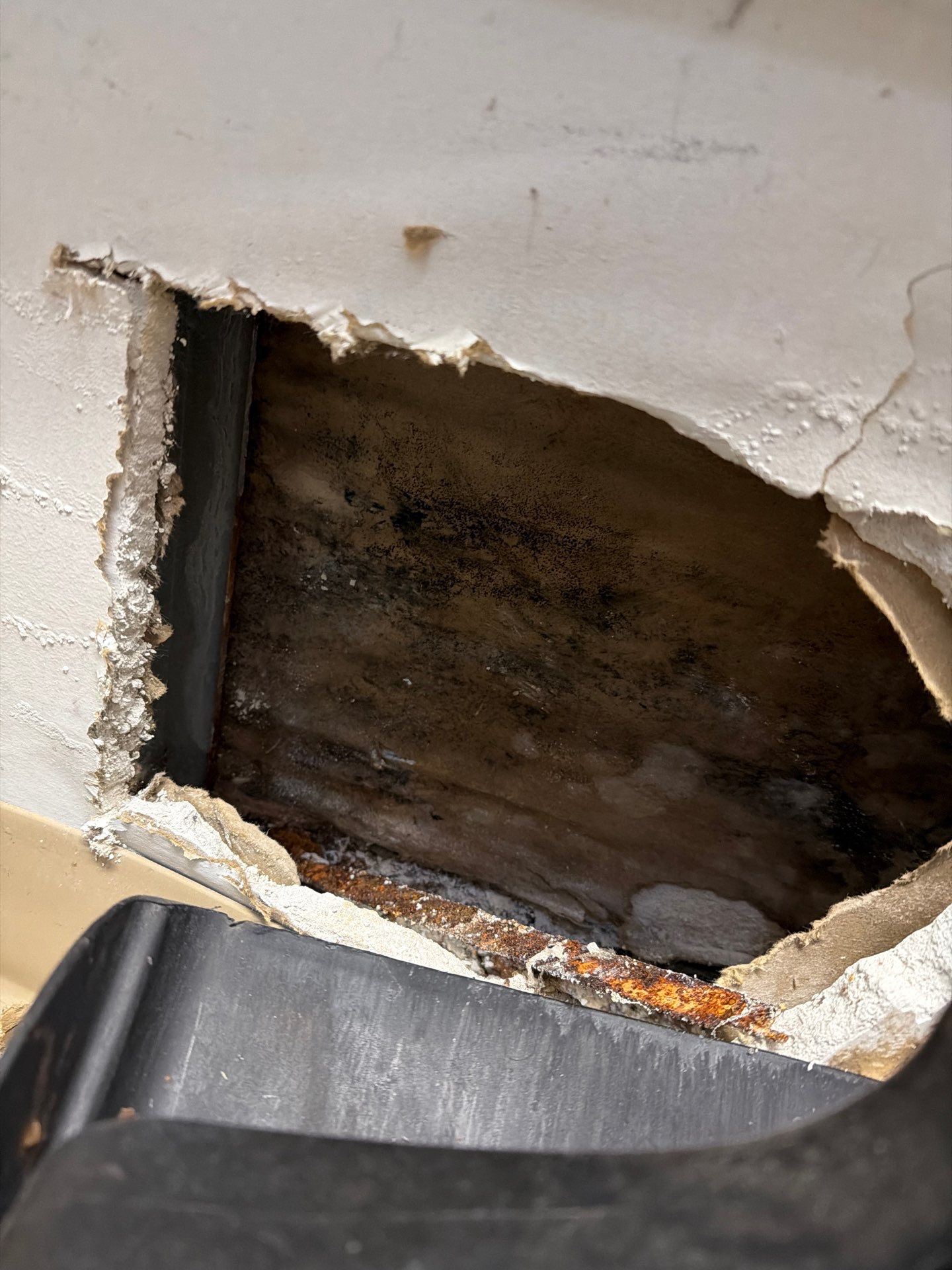
Step 1: Emergency Call Intake (0 to 10 Minutes)
- Call Sweet Briar Water Restoration dispatch. Average answer time is under 90 seconds, 24/7.
- Provide the loss address in Sweet Briar, water source, square footage affected, and time the leak started.
- Dispatch classifies the water under IICRC S500: Category 1 (clean), Category 2 (gray), or Category 3 (black).
- You receive an ETA, usually 60 to 90 minutes inside our central Indiana service radius.
- Shut off the water source if safe. Kill power to affected circuits if water has reached outlets.
- Document the start time of the leak. Mold colonization risk climbs sharply after the 48 hour mark.
- Move small valuables, electronics, and paper documents to a dry room above the affected area.
Step 2: On-Site Assessment (Minutes 0 to 30 After Arrival)
- Crew lead documents the loss with photos and a moisture map before any extraction begins.
- Moisture readings are taken with a penetrating meter (target: under 16% in wood, under 1% in concrete after drying).
- Thermal imaging scans walls and ceilings for hidden migration. Water travels laterally up to 30 feet from the source.
- Affected square footage is measured. A 500 sq ft loss requires roughly 5 air movers and 1 LGR dehumidifier per 150 sq ft.
- Scope and pricing are reviewed with you before work starts. Insurance contact info is collected if applicable.
- A baseline dry standard reading is taken from an unaffected room of the same construction type.
- The crew lead flags any safety hazards: slip risk, ceiling sag, asbestos suspect materials in pre-1985 homes.
Step 5: Antimicrobial Application (Hour 3 to Hour 5)
- EPA registered antimicrobial is applied to all affected substrates per IICRC S500 guidance.
- Dwell time is observed, typically 10 minutes before drying equipment is activated.
- Category 2 and 3 losses receive a second application after structural cleaning.
- Air scrubbers with HEPA filtration are staged for the duration of the job on contaminated losses.
- Product selection is logged on the job file for adjuster review, including EPA registration number and dilution ratio.
- Occupants and pets are kept out of the treated area until the antimicrobial has fully dried.
Step 6: Drying Equipment Placement (Hour 4 to Hour 6)
- Air movers are placed at 12 to 16 foot spacing along walls, angled at 10 to 45 degrees.
- One LGR (low grain refrigerant) dehumidifier is set per 1,000 to 1,500 cubic feet of affected space.
- Target indoor conditions: 70 to 90 degrees F, relative humidity below 40%, grains per pound below 50.
- Specialty drying mats are deployed on hardwood. Pressure drying systems are used on wall cavities.
- Equipment runs 24/7. Do not unplug units. Each air mover off for 8 hours adds roughly a day to the dry-out.
- Power draw is calculated against available circuits. A typical residential job uses 15 to 25 amps across two or three 20 amp circuits.
- Containment plastic is hung on losses exceeding 400 sq ft to reduce dehumidifier load and accelerate drying.
Step 4: Controlled Demolition (Hour 2 to Hour 4)
- Drywall is flood-cut at 24 inches above the waterline if saturation exceeds 16% moisture content.
- Wet insulation is removed and bagged. It does not dry effectively in place.
- Baseboards are pulled and labeled for reinstall when salvageable.
- Tack strips are removed if rusted. Subfloor is inspected for delamination.
- For Category 3 losses such as sewage, demolition is more aggressive. Review our sewage cleanup protocols for the exact removal scope.
- Cabinet kickplates are removed to expose toe-kick cavities, a common hidden moisture pocket.
- Ceiling tiles in finished basements are pulled if more than 25% of the field is stained or sagging.
Common Pitfalls to Avoid
- Do not run household fans in place of professional air movers. CFM output is roughly one third of commercial units.
- Do not open windows when outdoor dew point is above 55 degrees F. You add moisture instead of removing it.
- Do not lift wet carpet yourself without backing protection. Delamination ruins otherwise salvageable carpet.
- Do not delay calling for service to "see if it dries on its own." Hidden cavity moisture rarely self-resolves before mold begins.
- Do not discard damaged materials before documentation. Adjusters require photos and itemized lists.
Step 8: Final Verification and Sign-Off (Day 3 to Day 7)
- Final moisture readings are recorded against the dry standard.
- Equipment is removed once all materials hit target values.
- A completion report with photos, readings, and equipment hours is generated for your adjuster.
- Reconstruction scope is reviewed. For a full cost breakdown, see our water damage restoration cost guide.
- Reconstruction phase begins: drywall, insulation, paint, flooring, trim.
- A 30 day follow-up call confirms no secondary issues such as cupping floors or musty odors have appeared.
Step 7: Daily Monitoring (Day 1 Through Day 3 or 4)
- A technician returns every 24 hours to log moisture readings on the same documented points.
- Equipment is repositioned as wet spots reach dry standard. Air movers are pulled progressively.
- Drying goal: structural materials within 4% of an unaffected dry standard reading from the same room.
- Most Category 1 residential losses dry in 3 to 4 days. Category 2 averages 4 to 5. Hardwood and plaster can run 5 to 7.
- Daily psychrometric data is saved for your insurance file.
- If readings stall for 24 hours, the crew lead adjusts strategy: adding heat, adding dehumidification, or opening additional cavities.
Key Numbers to Remember
- Mold growth window: 48 to 72 hours
- Average mitigation cost in Sweet Briar: $1,500 to $4,500 for residential
- Insurance deductible range: $500 to $2,500 typical
- Equipment runtime: 72 to 96 hours minimum
- Response window for same day service in Sweet Briar: 60 to 90 minutes
- Target wood moisture content after drying: under 16%
- Target relative humidity during active drying: under 40%
Step 3: Water Extraction (Hour 1 to Hour 3)
- Truck-mounted or portable extractors remove standing water at 100 to 200 gallons per hour.
- Weighted extraction wands are used on saturated carpet, pulling up to 90% of trapped water from pad and backing.
- Non-salvageable pad is cut and bagged. Carpet is typically floated for under-drying.
- For deeper standing water, see our water extraction services overview for capacity specs and pricing.
- Contents are blocked up on foam or foil to prevent stain transfer onto wood floors.
- Submersible pumps are deployed for losses exceeding 2 inches of standing water, moving up to 60 gallons per minute.
- Crawlspaces are extracted with dedicated equipment to prevent vapor migration into living areas above.